
Quick Answer Box
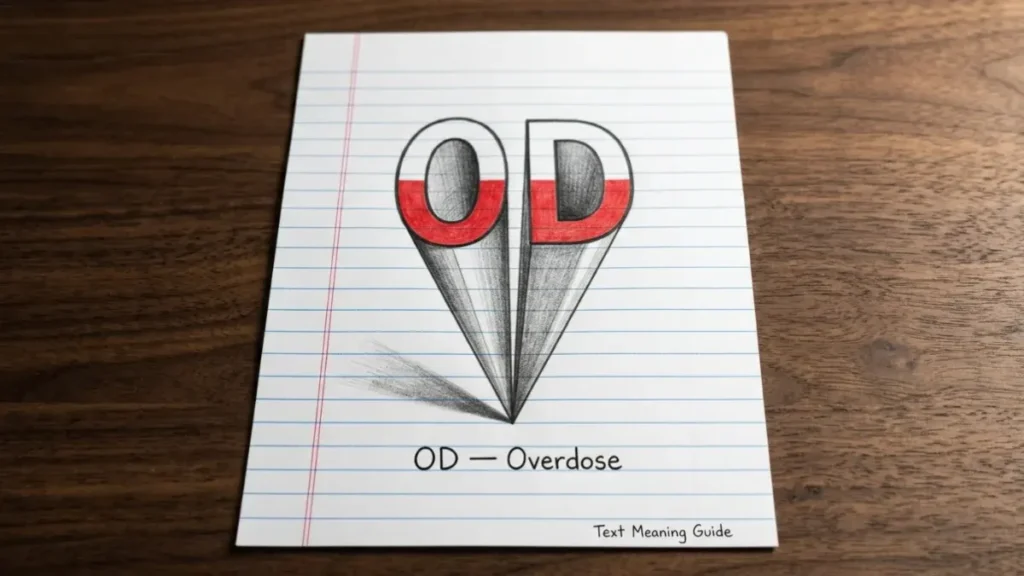
OD has multiple meanings depending on the context. In texting and social media, OD most commonly means “overdoing it” or “too much,” and among Gen Z it is often used to mean “really” or “very” for emphasis (e.g., “That movie was OD funny”). In gaming, OD can also mean “Overpowered,” describing something unusually strong. Outside of internet slang, OD is widely recognized in medical contexts as an abbreviation for “overdose.” You’ll commonly see OD on Snapchat, TikTok, Instagram, WhatsApp, X (formerly Twitter), Facebook, and Discord. The exact meaning depends entirely on the conversation and context.
Introduction
You are scrolling through your TikTok feed, and someone comments “Od Mean in Text” under a video. Or maybe a friend texts you “I’m OD tired.” Or you hear a news report about an “OD.” Suddenly, you are confused because that same two-letter abbreviation seems to mean completely different things. You are not alone. The word “OD” is one of the most flexible abbreviations in modern English, and it shows up everywhere—from hospital charts to gaming chats to Snapchat stories.
Understanding what “OD” means in the right context can save you from awkward misunderstandings. It can also help you connect with younger generations, understand medical conversations, and even improve your gaming communication. In this article, we will break down every single meaning of “OD” so you will never get confused again. We will cover medical definitions, social media slang, gaming terms, and even dangerous uses. By the end, you will be an expert on this tiny but powerful abbreviation.
Quick Facts Table
| Feature | Details |
|---|---|
| Meaning | Overdose / Overdoing it / Right Eye (medical) / Overpowered (gaming) |
| Pronunciation | Oh-Dee (two separate letters) |
| IPA | /ˌoʊ ˈdiː/ |
| Part of Speech | Noun, Verb, Adverb (slang), Adjective (slang) |
| Word Type | Acronym / Abbreviation |
| Difficulty Level | Easy (Grade 3+) |
| Common Usage | Texting, social media, healthcare, gaming |
| American English Usage | Very common across all age groups |
Simple Meaning
In plain, everyday English, “OD” most often means “overdose.” That is the original and most serious definition. It refers to taking too much of a drug or medicine, which can be very dangerous.
But here is the twist: in texting and on apps like TikTok and Snapchat, “OD” usually means “too much” or “overdoing it.” When a Gen Z kid says “That pizza is OD good,” they mean “that pizza is really good” or “that pizza is extremely good.” So, in slang, “OD” works just like the word “very” or “super.” It is a way to add extra emphasis to something.
Detailed Meaning
The abbreviation “OD” has multiple layers of meaning that depend entirely on the situation. Let’s break down the core definitions.
First, the medical and literal definition is “overdose.” An overdose happens when someone takes more than the safe or recommended amount of a substance. This could be prescription pills, illegal drugs, or even alcohol. In this context, “OD” is a serious noun and verb. You can say “He had an OD” (noun) or “He OD’d on painkillers” (verb).
Second, the slang definition has evolved from that serious meaning. Young people started using “OD” to describe anything that feels like “too much” in a less dangerous way. For example, if a party is crazy loud and crowded, you might say “This party is OD.” It does not mean anyone is in danger—it just means the energy is overwhelming. Over time, the slang shifted again. Now, “OD” is often used as an intensifier, meaning “very” or “extremely.” So “She is OD pretty” simply means “She is very pretty.”
Third, in the medical field, “OD” also stands for oculus dexter, which is Latin for “right eye.” Eye doctors use this abbreviation on prescriptions and charts. So if your eye doctor writes “OD” on your glasses prescription, they are talking about your right eye, not an overdose.
Fourth, in gaming, “OD” can mean “overpowered.” A weapon, character, or ability that is too strong and makes the game unfair is often called “OP,” but some gamers use “OD” in the same way.
As you can see, the meaning of “OD” is like a chameleon. It changes color based on its environment. The key to understanding it is always looking at the context and the platform where you see it.
Word Origin (Etymology)
The story of “OD” starts in the medical world. The word “overdose” itself has been around since the 1700s. It comes from the prefix “over-” meaning “too much” and the word “dose,” which comes from the Greek word dosis meaning “a giving” or “a portion.” So literally, “overdose” means “too large a portion.”
The abbreviation “OD” became popular in the 20th century, especially in hospitals and police reports. It was a quick, efficient way to write “overdose” on paperwork. By the 1960s and 1970s, during the counterculture movement, “OD” entered everyday speech as people talked more openly about drug use.
The slang transformation happened much later. Around the 2010s, with the rise of social media and texting, young people started borrowing serious words and using them in casual, exaggerated ways. “OD” followed this pattern. It went from a scary medical term to a casual way to say “too much” and finally to a simple intensifier meaning “very.” Today, the abbreviation is fully embedded in internet culture, especially among Gen Z.
Pronunciation Guide
- IPA: /ˌoʊ ˈdiː/
- Easy Pronunciation: “Oh-Dee”
- Syllables: Two syllables. First syllable “Oh” (like the letter O) and second syllable “Dee” (like the letter D).
- Stress: The stress is on the second syllable: oh-DEE.
In American English, native speakers say it quickly and smoothly. It sounds just like saying the two letters “O” and “D” one after the other. There is no variation in pronunciation between the medical and slang meanings. They all sound the same.
Part of Speech
“OD” is flexible and can act as multiple parts of speech:
- Noun: “He suffered an OD.” (Refers to the event of an overdose)
- Verb: “She OD’d on sleeping pills.” (Refers to the action of overdosing)
- Adverb (Slang): “This food is OD spicy.” (Modifies the adjective “spicy” to mean “very”)
- Adjective (Slang): “That party was OD.” (Describes the party as “too much” or “crazy”)
- Abbreviation (Medical): “OD means right eye.” (It functions as a label)
Grammar Notes
- Verb Forms: The verb “to OD” is regular. The past tense and past participle are “OD’d” or “ODed.” The present participle is “OD’ing” or “ODing.” For example: “He is OD’ing right now” or “He OD’d last night.”
- Plural (Noun): The plural of OD (when used as a noun meaning overdose) is “ODs.” For example: “The hospital saw three ODs this week.”
- Countable vs. Uncountable: When referring to an overdose event, it is countable (one OD, two ODs). When referring to the act of overdoing something in slang, it is often uncountable (e.g., “That’s OD”).
- Capitalization: In formal medical writing, “OD” is often capitalized. In casual texting and social media, it is usually written in lowercase “od,” but either way is accepted.
Real-Life Meaning
Imagine you are an American teenager named Jamie. Jamie texts their friend: “I ate OD cake at the party and now I feel sick.” Jamie does not mean they ate a dangerous amount of drugs. They simply mean they ate too much cake—they overdid it. The word is exaggerated for humor and emphasis.
Now imagine Jamie’s mom is a nurse. She comes home and says to her husband, “We had an OD in the ER today.” She means a patient came in with a drug overdose. It is a serious, professional statement.
Now imagine Jamie is at the eye doctor. The doctor says, “Your OD is 20/20.” The doctor is talking about Jamie’s right eye vision.
Same three letters, three completely different lives. That is the real-life magic of “OD.” It is a word that connects the mundane, the medical, and the playful all at once.
Example Sentences
Here are 15 natural example sentences showing “OD” in different contexts:
- School: “I OD’d on homework last night and barely slept.”
- Business: “Our marketing team OD’d on the campaign budget.”
- Healthcare: “The paramedics saved the patient from a fatal OD.”
- Technology: “My phone is OD slow today.”
- Daily Life: “I put OD salt on my eggs by accident.”
- Sports: “He trained OD hard and pulled a muscle.”
- Legal: “The defendant was charged with possession after the OD.”
- Office: “My boss is OD strict about deadlines.”
- Family: “My little brother is OD annoying right now.”
- Medical: “The prescription says OD for the right eye.”
- Slang: “That movie was OD boring.”
- Texting: “I’m OD tired, going to bed.”
- Gaming: “That new character is OD.”
- Social Media: “She has OD followers on TikTok.”
- Emergency: “The 911 call reported a possible OD at the apartment.”
od abbreviation meaning
At its most basic level, “OD” is an abbreviation. It stands for different things depending on the field. In general conversation, it is shorthand for “overdose.” However, because the English language loves efficiency, “OD” has become a catch-all abbreviation for anything excessive.
When someone asks “What does OD mean?” without any context, the safest answer is “overdose.” But in the digital age, you must always ask for context. On Twitter, “OD” might mean “overdramatic.” On a forum, it might mean “original design.” The abbreviation is a blank canvas that the internet paints on.
The beauty of “OD” as an abbreviation is its simplicity. It is quick to type—just two letters. That is why it survives and thrives in a world of 280-character tweets and quick text replies. It saves time and space while delivering a punchy meaning.
od meaning medical
In the medical world, “OD” has two primary meanings, and they could not be more different.
1. Overdose: This is the most common medical meaning. Emergency rooms, poison control centers, and ambulances use “OD” to document and communicate about drug overdoses. It is a critical term that signals immediate danger. Medical professionals use it in charts, radio calls, and shift reports. For example, a doctor might say, “We have a suspected opioid OD in room 4.” This usage is serious and life-or-death.
2. Oculus Dexter (Right Eye): This is the second medical meaning. Eye doctors (ophthalmologists and optometrists) use “OD” to refer to the right eye. It comes from Latin. The left eye is “OS” (oculus sinister). When you get an eye exam, your prescription will list “OD” for your right eye and “OS” for your left eye. Sometimes you will also see “OU” (oculus uterque), which means both eyes. So if an eye doctor says “Your OD is 20/30,” they are telling you the vision in your right eye.
Knowing these two medical meanings is crucial. If you are in a hospital, “OD” likely means overdose. If you are in an eye clinic, “OD” likely means right eye. The setting tells you everything.
od meaning death
The connection between “OD” and death is tragically real. An overdose can be fatal. When someone dies from taking too much of a substance, it is often called a “fatal OD” or simply “death by overdose.”
In news headlines, you will often see phrases like “Celebrity Dies of Apparent OD” or “OD Deaths Rise in the City.” In this context, “OD” is a direct synonym for a deadly drug incident. It is a heavy, somber term.
However, in slang, when someone says “I’m OD dead” or “This is OD killer,” they are not talking about actual death. They are using exaggerated language to describe something extremely funny or exhausting. For example, if a comedian tells a hilarious joke, a young person might comment, “I’m OD dead.” They mean they are laughing so hard they feel like they are dying. It is hyperbole—exaggeration for effect. It is important to recognize that this casual use is very different from the literal medical meaning.
i smoke od meaning
If someone says “I smoke OD,” they are using “OD” in a specific way related to cannabis or tobacco culture. This phrase usually has two possible meanings.
First, it can mean “I smoke too much.” The person is admitting they overdo it with smoking. They might be saying they smoke more than is healthy or more than they should. It is a form of self-awareness.
Second, and more commonly in modern slang, it means “I smoke a lot” or “I smoke very heavily.” The “OD” acts as an intensifier. It is like saying “I smoke a ton” or “I smoke heavily.” The person is bragging about their tolerance or their consumption level. For example, a teenager might post a video of themselves with a blunt and caption it “I smoke OD.” They are not saying they are in danger of an overdose; they are saying they are a heavy user.
This usage is strictly informal and should never be confused with actual medical overdoses. In casual conversations among friends, it is a common phrase, but it reflects a casual attitude toward substances.
od meaning slang gaming
In the gaming world, “OD” usually stands for “overpowered” or “overdoing it.” Gamers love abbreviations, and “OD” fits right in with “GG” (good game), “OP” (overpowered), and “AFK” (away from keyboard).
When a gamer says “That weapon is OD,” they mean the weapon is too strong. It gives the player an unfair advantage. It makes the game less fun for other players because it is so powerful that nobody can compete. For example, in a first-person shooter game, if a new gun kills enemies in one shot, players will call it “OD.” The developers might need to “nerf” it (weaken it) to balance the game.
Sometimes, “OD” can also mean “overdoing it” in a strategic sense. If a player uses too many resources or tries too hard, their teammates might say, “Bro, you’re OD.” It means they are being excessive or trying too aggressively.
Gamers also use “OD” as an adverb, similar to the general slang. For instance, “He is OD good at this game” means he is extremely good. The gaming community has fully adopted “OD” as a versatile piece of jargon.
what does od mean tiktok
On TikTok, “OD” is everywhere. It is one of the platform’s favorite slang terms. TikTok users have transformed “OD” into a casual intensifier that you will see in comments, captions, and video voiceovers.
On TikTok, “OD” almost always means “very,” “really,” or “extremely.” You will see comments like:
- “This is OD funny.”
- “She ate that up OD.”
- “I’m OD bored.”
TikTok also uses “OD” to mean “overdoing it” or “extra.” If someone is dancing too hard or putting too much effort into a simple trend, comments might say “You’re OD.” It is a playful roast.
The platform has also contributed to the evolution of “OD” into new phrases. For example, “OD glazing” means excessively praising someone. “OD cringe” means very cringeworthy. TikTok’s fast-paced, trend-driven environment keeps “OD” fresh and constantly evolving. If you are on TikTok and you see “OD,” think of it as a volume knob turned all the way up.
what does od mean on snapchat
On Snapchat, “OD” carries the same slang meaning as on TikTok. It means “very” or “too much.” Snapchat is all about quick, casual communication through snaps and chats, so abbreviations are essential.
When a Snapchat user says “I’m OD hungry,” they are telling their friend they are extremely hungry. When they say “This party is OD,” they mean the party is wild, crowded, or overwhelming.
However, because Snapchat is also used by a wide age range, the older generation on Snapchat might still use “OD” to mean “overdose.” But among Gen Z and younger millennials on the platform, the slang definition is dominant.
Snapchat also has a feature called “Snapstreaks,” and you might see someone say “OD commitment” to describe maintaining a long streak with a friend. It means “a lot of commitment.” In short, on Snapchat, “OD” is your go-to word for emphasis.
what does od mean in gen z slang
Gen Z (born roughly between 1997 and 2012) has fully adopted “OD” as a core piece of their vocabulary. In Gen Z slang, “OD” is an intensifier. It is used exactly like “very,” “super,” “hella,” or “mad.” For example:
- “That test was OD hard.”
- “Her outfit is OD fire.”
- “I’m OD excited for the concert.”
But Gen Z also uses “OD” as an adjective to describe something that is excessive or over-the-top. If a friend is being dramatic, you might say “You’re OD.” If a room is decorated with too many lights, you might say “That room is OD.”
What makes Gen Z’s use of “OD” unique is its flexibility. It can slide into almost any sentence. It has become a filler intensifier that adds flavor to everyday speech. It is informal, playful, and often ironic. Gen Z knows the word originally meant “overdose,” but they have reclaimed it and softened its meaning. This is a classic example of how younger generations take serious words and turn them into harmless slang. It is a form of linguistic creativity that makes their communication feel fresh and distinct.
Synonyms
Depending on the context, here are some synonyms for “OD”:
For Medical Overdose:
- Overdose
- Drug poisoning
- Toxic reaction
For Slang (“Too Much”):
- Excessive
- Overkill
- Extra
- Over-the-top
For Slang (“Very”):
- Extremely
- Really
- Super
- Hella (West Coast slang)
- Mad (East Coast slang)
For Gaming (Overpowered):
- OP (overpowered)
- Broken
- Game-breaking
Antonyms
Antonyms for “OD” also depend on the context:
For Overdose (Medical):
- Underdose
- Subtherapeutic dose
For “Too Much” (Slang):
- Moderate
- Balanced
- Understated
For “Very” (Slang):
- Slightly
- Mildly
- Barely
For Gaming (Overpowered):
- Underpowered
- Weak
- Nerfed
Similar Words Comparison
OD vs. OP: Both are gaming and slang terms. “OP” stands for “overpowered” and is the more common gaming term. “OD” is often used the same way but is less traditional. In general slang, “OP” can also mean “original poster” on Reddit, while “OD” never means that. So, “OP” has a different set of meanings.
OD vs. Overkill: “Overkill” is the standard English word for “too much.” “OD” is the slang abbreviation. They are interchangeable in slang, but “OD” is cooler and more casual. For example, “That is overkill” vs. “That is OD.”
OD vs. OT: “OT” means “overtime” or “off-topic.” Do not confuse them. “OD” is about excess; “OT” is about time or topic.
Common Phrases
Here are 10 common phrases that use “OD”:
- OD on – “I OD’d on coffee this morning.” (Consumed too much)
- OD good – “This burger is OD good.” (Very good)
- OD tired – “I’m OD tired.” (Very tired)
- OD extra – “She is being OD extra today.” (Overly dramatic)
- OD high – “The prices are OD high.” (Very high)
- OD fast – “He runs OD fast.” (Very fast)
- OD cringe – “That video is OD cringe.” (Very embarrassing)
- OD fire – “Her new song is OD fire.” (Very good)
- OD dead – “I’m OD dead.” (Exhausted or laughing hard)
- OD risky – “That stunt is OD risky.” (Very dangerous)
Idioms
While “OD” itself is not an idiom, it is often used in idiomatic expressions in slang:
- “OD on the sauce” – Drinking too much alcohol.
- “OD on the hype” – Getting too excited about something.
- “Going OD” – Becoming excessive or extreme.
Collocations
Common words that pair naturally with “OD”:
- Suffer an OD
- Die from an OD
- OD on drugs
- OD on sugar
- OD on screen time
- OD level (meaning the level of excess)
- OD vibes (meaning extreme energy)
- OD energy
- OD flavor
Common Mistakes
Here are common mistakes people make with “OD”:
Mistake 1: Using it in formal writing. Do not write “OD” in a formal business email or academic paper. It is too casual. Use “overdose” or “excessive” instead.
Mistake 2: Confusing medical and slang. If you are talking to a doctor, “OD” means overdose or right eye. Do not say “I’m OD tired” to your physician. They will be confused.
Mistake 3: Overusing it. Like any slang, using “OD” too much can make you sound repetitive. Mix it up with other words like “super” or “really.”
Mistake 4: Capitalization. In medical writing, capitalize it. In texting, lower case is fine. Consistency is key.
Professional Usage
In professional settings, you should avoid “OD” unless you are in healthcare. In healthcare, “OD” is standard and accepted for both “overdose” and “right eye.” Nurses, doctors, and pharmacists use it daily.
In business, law, or education, do not use “OD” in reports or presentations. Instead, use full words. For example, say “The patient suffered a drug overdose” or “The team was excessive in its spending.”
However, in creative industries like marketing or advertising, using “OD” in internal chats or casual brainstorming sessions is fine. It can build camaraderie and show you are in touch with modern language.
Academic Usage
In academic writing, “OD” is almost never used. English professors and academic journals prefer formal language. You would write “overdose” or “excessive.”
The only academic exception is in medical or pharmacy textbooks, where “OD” is used as a standard abbreviation. In psychology or sociology papers discussing drug use, you might see “OD” in quotes or informal examples, but the formal body of the text should use “overdose.”
Business Usage
In the business world, “OD” has limited use. It might appear in internal Slack channels or quick emails among colleagues, but never in official documents. For example, a manager might Slack their team: “We OD’d on the budget this quarter.” It is casual and humorous.
Some business professionals might use “OD” to mean “organizational development,” which is a field of study. But that is a less common usage and is usually spelled out.
Social Media Usage
Social media is where “OD” thrives. On Instagram, Twitter, TikTok, Snapchat, and even Facebook, “OD” is a staple of casual communication. It appears in hashtags (#OD), comments, captions, and direct messages.
Influencers use “OD” to connect with younger audiences. Brands use it in memes to seem trendy. The key on social media is to keep it natural and fun. Forced usage comes across as “cringe” (which, ironically, is something you could call “OD cringe”).
Frequently Asked Questions
1. What does OD mean in text messaging?
In text messaging, “OD” usually means “overdose” in a literal sense, but among younger people, it often means “too much” or “very” as slang.
2. Is OD a bad word?
No, not inherently. But in its medical context, it refers to a dangerous situation. In slang, it is harmless and informal.
3. What does OD mean on Instagram?
On Instagram, “OD” is slang for “very” or “too much,” similar to TikTok and Snapchat.
4. Can OD mean right eye?
Yes, in eye care, “OD” stands for oculus dexter, which is Latin for right eye.
5. What does OD stand for in drugs?
In drugs, “OD” stands for “overdose,” which means taking too much of a substance.
6. Is OD a Gen Z word?
Yes, Gen Z popularized the slang use of “OD” as an intensifier meaning “very.”
7. How do you use OD in a sentence?
You can say “I’m OD hungry” (slang) or “He had an OD” (medical).
8. What is the difference between OD and OP?
“OD” is often slang for “very” or “too much,” while “OP” is more commonly used in gaming for “overpowered” or on Reddit for “original poster.”
Key Takeaways
- “OD” has multiple meanings: overdose, right eye, overdoing it, very.
- The meaning depends entirely on context (medical, gaming, social media).
- In Gen Z slang, “OD” is an intensifier meaning “really” or “extremely.”
- On TikTok and Snapchat, “OD” is casual and playful.
- In medical settings, “OD” is serious—it means overdose or right eye.
- Never use “OD” in formal academic or business writing.
- The pronunciation is always “Oh-Dee.”
Conclusion
The abbreviation “OD” is a masterclass in how language evolves. What started as a serious medical shorthand for “overdose” has spun off into a dozen different meanings across platforms and generations. Today, “OD” is a chameleon. It can save a life in an emergency room, describe a tasty burger on TikTok, or help a gamer complain about an unfair weapon.
The key to mastering “OD” is paying attention to your audience and your platform. Are you texting a friend? Use “OD” freely as slang. Are you writing a paper? Spell it out. Are you in a hospital? Know that it means overdose or right eye. By understanding all these layers, you are now equipped to use and interpret “OD” perfectly in any situation.
Language belongs to the people who use it. And right now, “OD” belongs to everyone—from doctors to teenagers to gamers. And now, it belongs to you too.