
Quick Answer Box
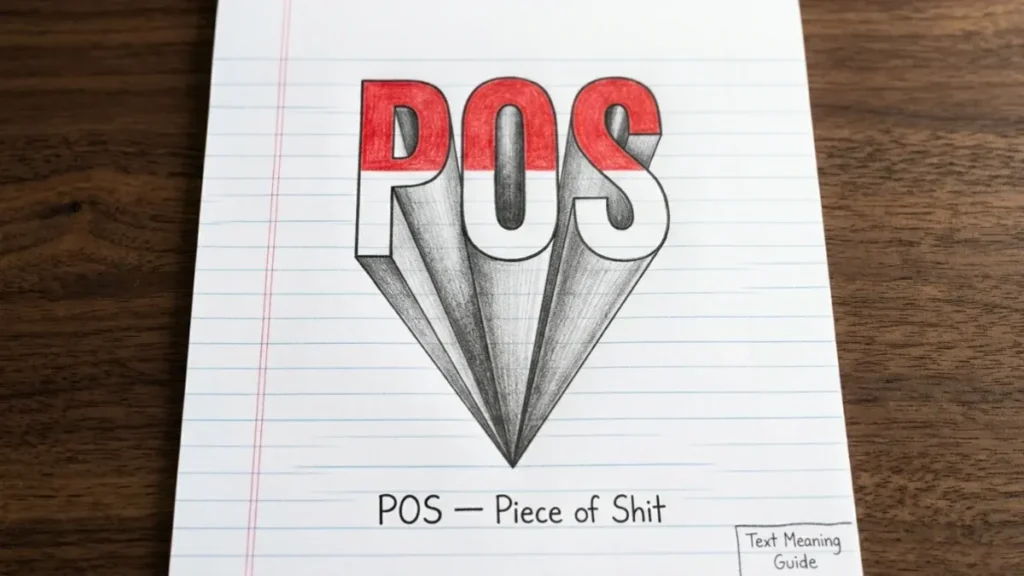
POS is an abbreviation with several meanings, and the correct interpretation depends entirely on the context. In text messages and on social media, POS meaning in text most commonly refers to “Piece of S*,”** a slang insult used to describe someone or something negatively. However, in retail and banking, POS stands for Point of Sale, the system or location where customers complete a purchase. In medical discussions, POS can also refer to Polycystic Ovary Syndrome, a hormonal condition. You’ll often see POS used across TikTok, Snapchat, Instagram, Twitter/X, WhatsApp, and other messaging apps, where context is essential for understanding its meaning. In this guide, you’ll learn what POS means in texting, its business and medical definitions, and real-life examples so you can identify the correct meaning in any conversation.
Introduction
Have you ever come across the three little letters “POS” and found yourself scratching your head? You are not alone. In today’s fast-paced world, the same acronym can mean something entirely different depending on whether you are swiping your credit card at a store, reading a tweet, or visiting a doctor’s office.
Understanding the meaning of “POS” is crucial because misreading it can lead to embarrassing misunderstandings. If your friend texts you “POS,” they probably aren’t asking about payment systems. Similarly, if a bank manager uses the term, they are definitely not insulting a customer. This article will break down every single meaning of POS. Whether you are a student, a professional, a business owner, or just an everyday person scrolling through social media, this guide will help you understand and use “POS” correctly every single time.
Quick Facts Table
| Feature | Details |
|---|---|
| Primary Meaning (Retail) | Point of Sale |
| Primary Meaning (Slang) | Piece of S*** |
| Primary Meaning (Medical) | Polycystic Ovary Syndrome |
| Pronunciation | “Pee-Oh-Ess” (Spelled out) |
| IPA | /ˌpiː oʊ ˈɛs/ |
| Part of Speech | Noun (Acronym) |
| Word Type | Abbreviation / Initialism |
| Common Usage | Banking, Texting, Healthcare, Social Media |
| American English Usage | Extremely common in US retail and casual conversation |
Simple Meaning of POS
Imagine you are buying a candy bar at a gas station. The moment the cashier scans the item and you hand over your money, you are at the “Point of Sale.” That is the physical or digital place where a transaction happens.
Now, imagine you get a flat tire. You might mutter under your breath about the “Piece of S***” tire. That is the slang version.
Lastly, if a doctor mentions a condition related to hormones and ovaries, they might use the abbreviation POS for Polycystic Ovary Syndrome.
So, in simple terms: POS is a shortcut. It represents a place (like a checkout counter), an insult (something useless), or a medical condition.
Detailed Meaning of POS
While the letters remain the same, the meaning branches out into three distinct universes.
- The Commercial Universe (Point of Sale): This is the most formal and widely recognized definition in the business world. It refers to the specific time and place where a retail transaction is completed. At this point, the customer pays for goods or services, and the seller records the sale. This term has expanded to include the software and hardware used to process these transactions—think of the iPads at a coffee shop or the large touchscreens at a clothing store checkout.
- The Medical Universe (Polycystic Ovary Syndrome): In healthcare, POS refers to a common hormonal disorder affecting women of reproductive age. It involves irregular periods, excess androgen (male hormone) levels, and polycystic ovaries (ovaries with multiple small cysts). It is a serious condition that requires medical attention.
- The Slang Universe (Piece of S*):** This is where language becomes casual and emotional. Used in texting, gaming, and social media, calling something or someone a POS is a way to express extreme frustration, dislike, or disappointment. It can be directed at an object (like a broken phone) or a person (someone who did something mean).
Word Origin (Etymology)
The term “Point of Sale” originated in the retail industry in the 20th century. As businesses grew and cash registers became more advanced, the “point” simply meant the location where a sale was concluded.
The slang term “Piece of S***” has been around in English vernacular for centuries, but its abbreviation to “POS” exploded with the rise of internet chat rooms, texting, and character-limited platforms like Twitter (now X). People needed a fast way to express their anger, and the acronym stuck.
“Polycystic Ovary Syndrome” was medically named in the 1930s, combining “poly” (many), “cystic” (sac-like growths), and “ovary” (the female reproductive organ). The abbreviation POS (or more commonly PCOS) became standard in medical documentation.
Pronunciation Guide
- IPA: /ˌpiː oʊ ˈɛs/
- Easy Pronunciation: “Pee-Oh-Ess”
- Syllables: Pee (1), Oh (1), Ess (1).
- Stress: The stress is typically placed equally on all letters, or slightly stronger on the last “Ess.”
Important: You do not pronounce it as a single word like “Paws” or “Poss.” You must spell out each letter individually: P-O-S.
Part of Speech & Grammar Notes
- Part of Speech: Noun (Acronym).
- Countable vs. Uncountable: When referring to a machine (“We have ten POS systems”), it is countable. When referring to the concept (“We accept credit at the POS”), it is generally uncountable.
- Verb Forms: “POS” is not a verb. You cannot say “I will POS you.” However, you can use “Point of Sale” in a verb phrase (e.g., “We POS the transaction,” though this is informal business jargon). In slang, it is strictly a noun/adjective.
- Adjective Use: You can use it as an adjective. For example, “This POS car won’t start,” or “Our new POS system is very fast.”
POS Meaning in Banking
When you step into the world of finance, POS (Point of Sale) is king.
In banking, a POS transaction is any purchase made using a debit or credit card at a physical store or terminal. When you swipe, tap, or insert your card at a checkout counter, the bank processes this as a “POS Transaction.” It differentiates your card use from an ATM withdrawal or an online payment.
Banks pay close attention to POS activity. They use it to monitor for fraud; if a card is used at a POS terminal in New York and then another in London an hour later, the bank’s security system flags it. For business owners, understanding POS transactions is vital for reconciling accounts and managing cash flow.
POS Meaning in Retail & Systems
Retail is where the Point of Sale term truly shines. A POS System is the complete setup that allows a store to run.
Gone are the days of simple cash registers. Modern POS systems are sophisticated computers that manage inventory, track employee hours, send digital receipts, and analyze sales data. When you buy a shirt at a clothing store, the associate uses the POS system to scan the barcode (which deducts that shirt from the store’s inventory), calculates the tax, and accepts your payment. Without a POS system, a store cannot effectively track what it sells or what it needs to reorder.
POS Meaning as a Machine
A POS Machine (also called a POS Terminal) specifically refers to the physical hardware that processes the payment.
This is the device you see on the counter at a restaurant, the little square reader attached to an iPad, or the wireless handheld device a waiter brings to your table. These machines read credit cards via chip, magnetic strip, or NFC (Near Field Communication) for tap-to-pay. Their primary job is to securely capture the customer’s payment information and send it to the bank for approval.
POS Meaning in Medical
In healthcare, you will hear POS used in a medical context, though the more common abbreviation is PCOS (Polycystic Ovary Syndrome).
POS/PCOS is a condition that affects how a woman’s ovaries work. Symptoms often include irregular menstrual cycles, excess hair growth, acne, and difficulty getting pregnant. It is a leading cause of infertility. It is also associated with long-term health risks like diabetes and heart disease. If a doctor writes “POS” on a chart, they are likely referring to this syndrome. It is important to note that this is a very different, and much more serious, use of the term compared to the retail world.
POS Meaning in Slang & Texting
Slang is where things get informal. In text messages, chat rooms, and gaming lobbies, POS almost exclusively means “Piece of S*.”**
This is used to describe something that is low quality, broken, or frustrating. It can also be used to describe a person who has done something awful, selfish, or treacherous. The tone is harsh and emotional. It is not considered formal language, and you should avoid using it in professional emails or conversations with elders. However, it is very common among younger generations and in fast-paced online conversations where frustration runs high.
POS Meaning on Twitter (X)
On Twitter, the character limit used to be strict, so abbreviations flourished. When you see POS in a tweet, it is almost certainly the slang version.
Someone might tweet, “My boss is such a POS for making us work the holiday.” Or, “This phone is a POS, it keeps freezing.” It is used as a venting tool. Sometimes, it is paired with other acronyms like “POS & Proud” (though this is rare). If you see it in response to someone else’s post, it is usually an insult. However, occasionally, Twitter users may use it to discuss Point of Sale if they are in the small business or tech niche, but the context—the rest of the tweet—will make it clear. If you see “#POS” in a business trend, it’s about sales; if it’s in a rant, it’s an insult.
POS Meaning as a Tone Tag
This is a tricky one. A “tone tag” is a shorthand like /s (sarcasm) or /j (joking) used to clarify the emotional tone of a text. While POS is not a standard, widely recognized tone tag like /srs (serious), it can sometimes be used informally to mean “Piece of S***” as a way to tag a comment as an angry or derogatory outburst.
However, more commonly in grammar and linguistics (which relates to “tone” in a different sense), POS stands for “Part of Speech.” When writers or editors annotate text, they might mark a word’s “POS” to identify whether it is a noun, verb, adjective, etc. So, if you are reading a note about a “tone tag” or a grammatical analysis, POS likely refers to the grammatical category of a word, rather than the emotional tone of the message.
POS Meaning as a Person
When you hear someone say, “He is a POS,” they are using the slang meaning to describe a person.
Calling a person a POS is a severe insult. It suggests that the individual is worthless, untrustworthy, or morally bankrupt. You might hear this in heated arguments, breakups, or political commentary. For example, “The politician ignored the poor; he’s a POS.” It’s a strong statement of character judgment. In a business context, you would never call a “Point of Sale” a “person”; the “person” in retail is the “customer” or the “cashier.”
Real-Life Meaning
Scenario A (Retail): You are at your favorite local grocery store. You pick up milk and bread. You walk to the front of the store. The area with the cashier and the credit card reader is the “Point of Sale.” You hand your card to the cashier, they swipe it on the POS machine, and the transaction is approved.
Scenario B (Medical): Your friend hasn’t been feeling well. She visits her gynecologist. After some tests, the doctor explains she has POS (PCOS). This means she needs to manage her diet and probably take medication to regulate her hormones.
Scenario C (Slang): You are playing an online video game. Your teammate accidentally shoots you. You type in the chat, “Bro, you’re a POS.” You mean they are careless or frustrating, not that they are a machine or a medical condition.
Example Sentences (Context-Based)
Business & Banking (Point of Sale)
- The new POS system integrates our inventory directly with our online store.
- Please ensure the POS terminal is connected to the internet before the store opens.
- Our bank charges a small fee for every POS transaction made with a credit card.
- The cashier used the POS machine to issue a refund to the customer.
- We are upgrading our POS software to accept cryptocurrency.
Medical (Polycystic Ovary Syndrome)
- She was diagnosed with POS after experiencing irregular periods for several months.
- Managing diet and exercise is crucial for women with POS.
- The doctor specializes in reproductive health and treats many patients with POS.
Slang & Social Media (Piece of S***)
- I can’t believe my car broke down again; it’s a total POS.
- He cheated on his girlfriend; what a POS.
- This internet connection is a POS; I can’t even load a video.
- Stop being a POS and help us clean up.
- My old laptop is a POS, so I finally saved up for a new one.
- He left the restaurant without paying the bill; what a POS move.
- I dropped my phone and the screen cracked. This day is a POS.
Synonyms for Each Context
| Context | Synonyms |
|---|---|
| Point of Sale (Retail) | Checkout, Payment Terminal, Cash Register, Transaction Point, Kiosk. |
| Medical (Syndrome) | PCOS, Cystic Ovary Disorder, Hormonal Imbalance (context-specific). |
| Slang (Insult) | Jerk, Idiot, Junk, Garbage, Trash, Worthless, Loser, Crap. |
Antonyms for Each Context
| Context | Antonyms |
|---|---|
| Point of Sale (Retail) | Warehouse (where goods are stored before sale), Online Storefront (digital vs physical). |
| Medical (Syndrome) | Health, Normal Functioning, Wellness. |
| Slang (Insult) | Treasure, Gem, Hero, Champion, Valuable, Reliable. |
Similar Words Comparison
Here is how POS stands up against other confused acronyms.
| Acronym | Meaning | Usage |
|---|---|---|
| POS | Point of Sale / Piece of S*** | Retail or Casual Insult. |
| PCOS | Polycystic Ovary Syndrome | Medical (more common than POS). |
| POV | Point of View | Social Media (showing a perspective). |
| POD | Print on Demand | E-commerce (business model). |
| PPS | Post Post Scriptum | Letter writing (additional note). |
POS vs. POC: POC means “Person of Color” in social justice contexts or “Proof of Concept” in business. Never confuse these, as using POS in a diversity context would be highly offensive and incorrect.
Common Phrases & Collocations
- POS System: The entire hardware/software setup. (e.g., “We need a new POS system.”)
- POS Terminal: The physical card reader. (e.g., “The POS terminal is down.”)
- POS Transaction: The payment activity. (e.g., “POS transactions are up 20%.”)
- POS Software: The program running on the machine. (e.g., “Update the POS software.”)
- Total POS: A strong slang phrase meaning entirely worthless. (e.g., “This movie is a total POS.”)
- POS Data: Sales information collected at checkout. (e.g., “We use POS data to forecast trends.”)
- POS Hardware: The physical devices. (e.g., “The POS hardware is expensive.”)
- Mobile POS: A tablet or smartphone used as a checkout device. (e.g., “We use a mobile POS for outdoor events.”)
Common Mistakes
- Using “POS” in a Professional Medical Context instead of “PCOS”: While POS is understood, the standard medical abbreviation is PCOS. Using just “POS” might confuse other staff. Stick to PCOS for clarity.
- Using the Slang in a Business Meeting: Never say “Our POS is broken” if you mean the checkout machine. The IT department might think you are insulting the machine rather than fixing it. Say “The point-of-sale terminal is down.”
- Capitalization: While internet slang is often lowercase (“pos”), the formal business and medical abbreviations are typically uppercase (“POS”).
- Misunderstanding the “Tone Tag”: Assuming POS is a tone tag like /s. It is not standardized. If someone uses it as a tag, they likely mean “Part of Speech” in a linguistic context, not the emotional tone of a sentence.
Professional Usage
In a business environment, POS is a lifeline. Managers use POS reports to see which products are bestsellers and which are not. Accounting teams use POS data to track revenue in real-time. IT specialists manage POS networks to ensure they are secure from hackers, as these machines handle sensitive credit card information.
In a medical office, nurses and doctors document “POS” (usually PCOS) in patient charts to alert other specialists that the patient may require monitoring for diabetes or reproductive health issues.
Academic Usage
In schools, you are most likely to see POS used in Linguistics or English class to mean Part of Speech.
Teachers might annotate a student’s essay with “POS error” to indicate they misused a noun or verb. For example, if a student writes “The beautiful ran,” the teacher might write “POS error” because “beautiful” is an adjective, but it should be describing a noun (like “woman”), or the verb “ran” needs a subject. It is a grammar shorthand.
In computer science courses, students learn about POS tagging, which is a process in Natural Language Processing (NLP) where software assigns a part of speech to every word in a sentence.
Business Usage
For entrepreneurs and small business owners, POS is the heart of their sales operation.
Modern POS systems do more than just take money. They manage loyalty programs. For example, if you buy coffee ten times, the POS system tracks your purchases and automatically gives you the eleventh one free. They also manage employee scheduling and clock-ins. When a business wants to open a new location, they budget for new POS systems, which are considered essential assets.
Social Media Usage
On platforms like Instagram, TikTok, and Twitter/X, POS is almost universally the slang term.
You might see a meme captioned, “Me trying to fix this POS computer.” It is used for humorous rants. However, influencers in the finance or small business niche might use #POS to talk about Point of Sale strategies. Pay attention to the video or picture: if they are showing a cash register, it’s business; if they are showing a broken gadget, it’s slang.
Frequently Asked Questions (FAQs)
1. What does POS stand for in banking?
In banking, POS stands for Point of Sale. It refers to any debit or credit card transaction made at a physical retail location.
2. Is POS a bad word?
It depends on the context. As an acronym, it is neutral. However, as a slang abbreviation for “Piece of S***,” it is considered vulgar or offensive in formal settings.
3. What does POS mean on a card statement?
If you see “POS” on your bank statement, it indicates a purchase made at a physical store using your card. It helps you differentiate the purchase from an ATM withdrawal or online purchase.
4. What is the difference between POS and PCOS?
POS stands for Polycystic Ovary Syndrome, but PCOS is the more widely accepted and standardized medical abbreviation. Using PCOS is recommended to avoid confusion with Point of Sale.
5. What does POS mean in school?
In an educational setting, POS usually stands for Part of Speech. It relates to grammar categories like nouns, verbs, and adjectives.
6. Can POS mean “Parent Over Shoulder”?
While less common, occasionally in texting, POS has been used to mean “Parent Over Shoulder,” warning someone to stop typing something inappropriate. However, “POS” is more frequently used as “Piece of S***,” so be cautious.
7. What does POS mean on Twitter?
On Twitter, it most commonly means “Piece of S***” and is used to express frustration or insult someone. It is rarely used for “Point of Sale” unless the account is specifically about retail or business news.
8. Is a POS machine safe to use?
Yes, modern POS machines are highly secure and use encryption. However, you should always cover your hand when entering your PIN to protect yourself from potential skimming devices.
Key Takeaways
- Context is everything: Always look at the surrounding conversation or setting to know whether POS means “Point of Sale,” “Piece of S***,” or “Polycystic Ovary Syndrome.”
- Formal vs. Informal: Use “Point of Sale” or “PCOS” in professional and medical environments. Reserve the slang “Piece of S***” for casual texting or gaming.
- Pronunciation: Always pronounce it as individual letters: “Pee-Oh-Ess.”
- Business Tool: In retail, the POS system is a vital tool for tracking sales, inventory, and customer behavior.
- Avoid Misunderstandings: Never abbreviate “Part of Speech” as POS in a public document without clearly defining it first.
Conclusion
The term “POS” is a perfect example of how language evolves and adapts to different environments. One minute it is processing your grocery bill, the next it is a medical diagnosis, and the next it is an emotional outburst on social media. By understanding the context, you can navigate conversations in banking, healthcare, business, and casual social circles with complete confidence.
Next time you see “POS,” you won’t hesitate. You will know exactly what it means—whether you are swiping a card, reading a grammar book, or laughing at a meme about a broken car. Language is fluid, and knowing these distinctions keeps you informed and prevents embarrassing slip-ups in your daily life.